About the work
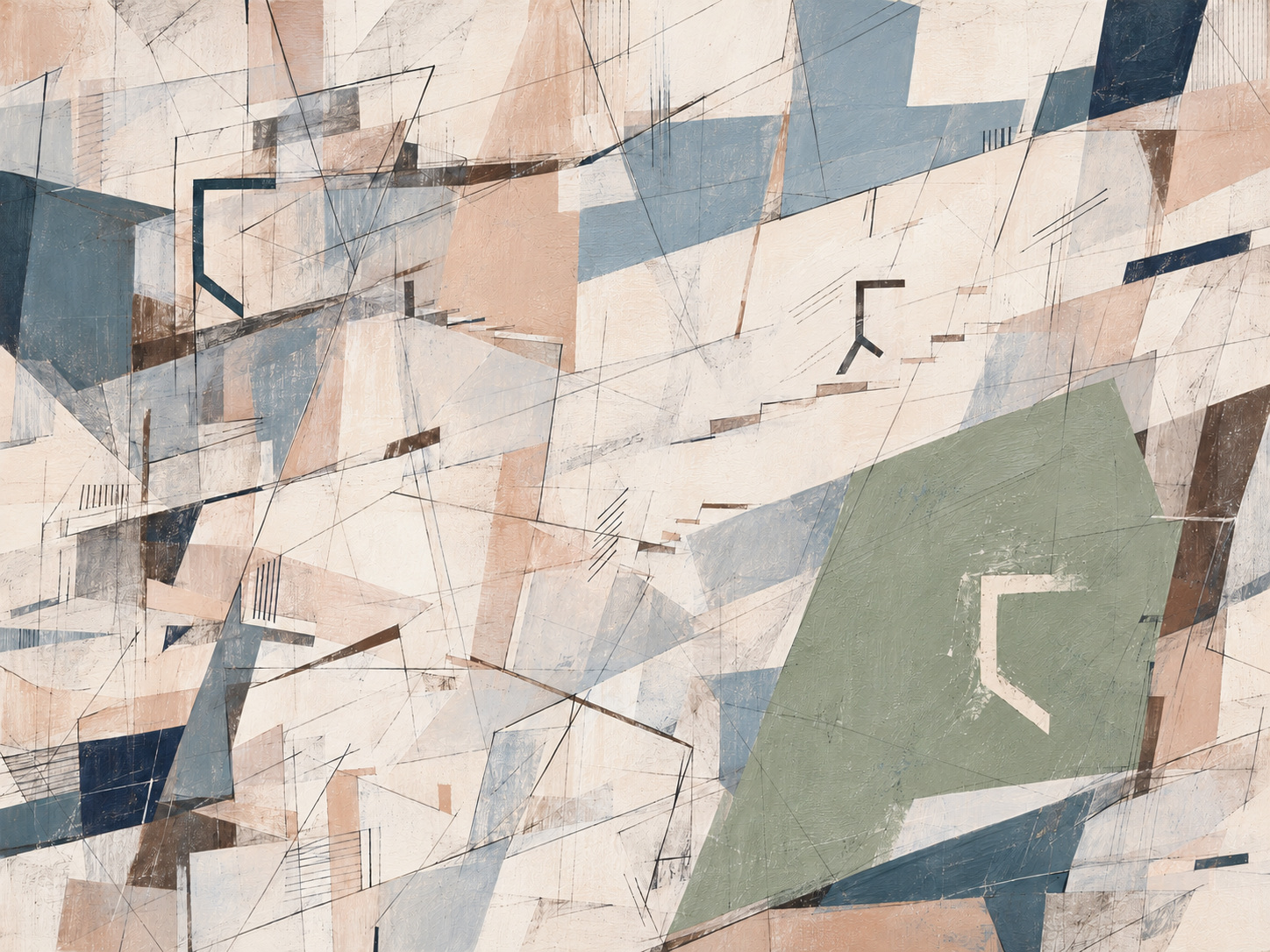
An angular mark appears again. Its shape is familiar, but its surroundings have changed. Among fine lines it seems to belong to a structure. Against an open field it acquires the suggestion of movement. Within a painted plane it becomes an interruption.
Between Seeing and Knowing explores how an image changes as we learn to read it. A detail that seemed incidental can become an organising feature when we notice its relationship to something else.
Something familiar, somewhere else
Painted planes overlap a fine network of drawn traces. Some lines establish an edge; others cross it or continue beyond what we can see. Changes of scale give the smaller marks a different presence from the larger shapes around them.
The recurring form offers a point of recognition. We find it again, then notice what has changed. Its weight, position and surrounding colour affect how it belongs to the composition. A familiar shape can begin to suggest something new.
Returning to the image
From a distance, the larger planes establish the rhythm. Closer attention brings forward scratches, interrupted lines and almost-aligned edges. We move between these scales, carrying what we have noticed into the next encounter.
The work leaves room for the associations a viewer brings. A mark might suggest a figure, a fragment of a structure or simply a gesture held in paint. Looking again can broaden that first understanding.
“The relation between what we see and what we know is never settled.”
References and making
John Berger's Ways of Seeing provides the conceptual starting point. His words invite attention to the relationship between seeing and understanding. Explore the book.
Julie Mehretu's Stadia II (2004) provided an artistic reference through its layered drawing, shifts in scale and simultaneous activity. Its political and historical concerns belong to her work. The new composition and its connection to marketing are AC's interpretation. View the museum record and hear the artist's commentary.
Created with AI image generation from an original AC composition brief. The drawn lines, acrylic passages and textured surface are digital interpretations, guided by AC's palette, with Haze Blue and Sage now taking roles in two existing planes alongside Gesso, Dust and retained dark anchors.
Continue in the Index
Explore How meaning takes shape