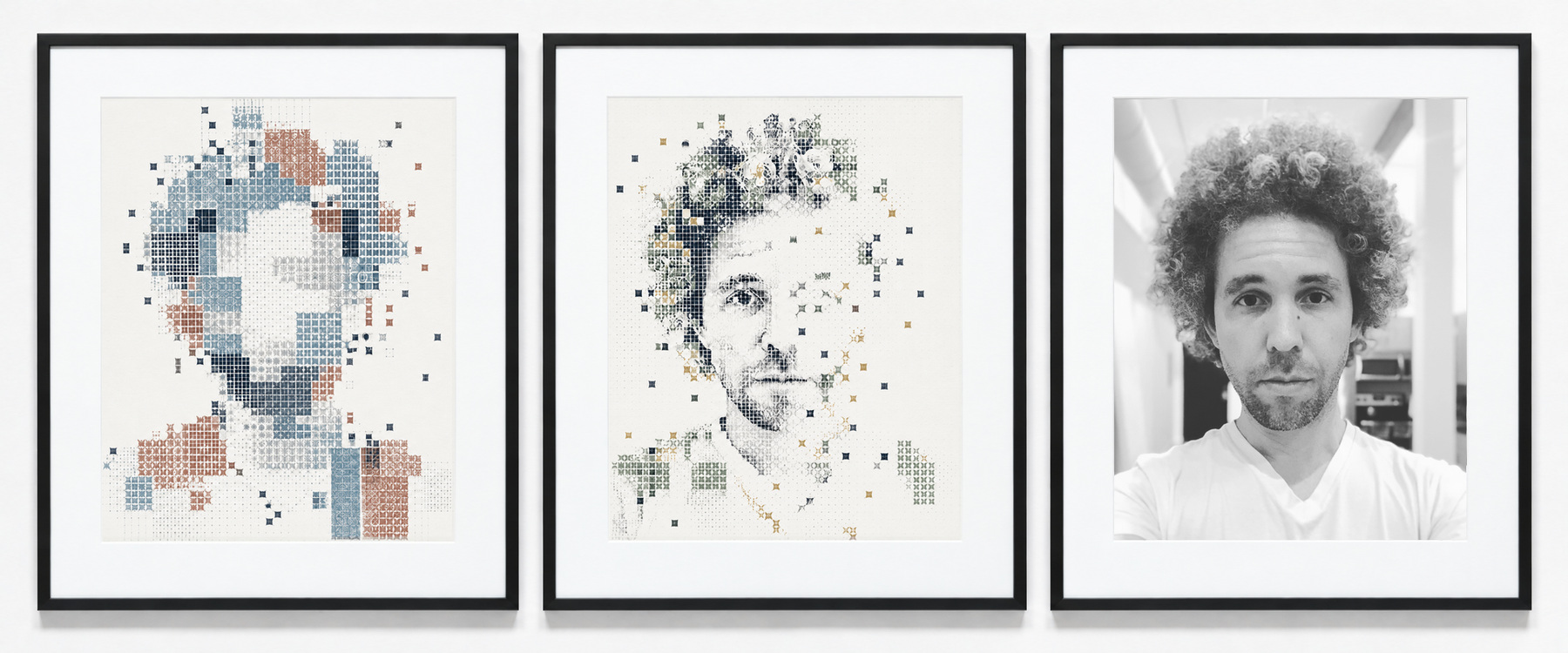
About the work
How much do we allow another person to change the picture we already carry?
We can recognize a human presence from very little. We can also look directly at someone and know very little about them. Between those possibilities is the question behind this work: when does recognition open our attention, and when does it let us stop looking?
Abstraction gives imagination somewhere to go. An interval can hold several possibilities at once; a mark can belong to a rhythm before it suggests a likeness. Recognizing a face does not exhaust those relationships. It gives us another way to encounter them.
What an encounter can change
An encounter does not stay neatly in the moment it happens.
A later conversation can give an earlier silence another meaning. A correction can change what we thought someone was asking. The past has not been rewritten, but the account we carry of it has moved.
Something similar can happen between these images. A mark first encountered as decoration may acquire another significance when we return to it. Nothing had to be hidden. Our attention changed.
That return matters as much as recognition itself. We do not only add detail to what we know. Sometimes what we learn asks us to rearrange it.
The grid gives relationships a visible order. Repetition lets one mark belong with another; an interruption leaves room for a different reading. Its precision can draw us closer, while the spaces it leaves open keep the image from settling into a single account.
Every representation makes choices. Something is brought forward; something else remains outside the frame. Those choices make expression possible. They also leave us with a question about the difference between what an image can hold and the life of the person it represents.
Giving an idea form can change the questions we are able to ask. What began as an intuition becomes something we can encounter and respond to. Making is part of that discovery. We may come to understand something through the act of shaping it that we could not have explained beforehand.
The person was never incomplete. A photograph holds a moment. The person continues beyond it.
There is another presence in the encounter: the person looking. We arrive with memories, associations and ways of noticing that the work could not contain on its own. Something in it may feel familiar for reasons no one else can see. Another viewer may find a relationship we never intended.
That interpretation belongs to them. It need not become an explanation offered back to us. Participation can be the quiet act of making meaning, or of allowing a familiar meaning to become less certain.
What we come to understand can change what we thought we had already seen.
Where the idea began
This piece took shape through dialogue with Avery Potter about attention, representation and how people participate in becoming known. Questions were clarified, assumptions challenged and earlier responses reconsidered. The developing images gave the conversation something to respond to; the responses changed what the images could become. Understanding and making moved together.
When Avery questioned the likeness being made of him, his correction changed the work. The final portrait uses the original self-portrait he chose to share. He was not only the subject of the image; he could question how he appeared.
The exchange leaves an open question within the work. What happens when we allow another person to change the terms on which we understand them?
The triptych's format was informed by Charles Gaines's Faces series. Explore the reference work at MoMA.
Explore how this idea informs personas, marketing and experience design in the Index.
Continue in the Index
Explore A Person Comes Into View