About the work
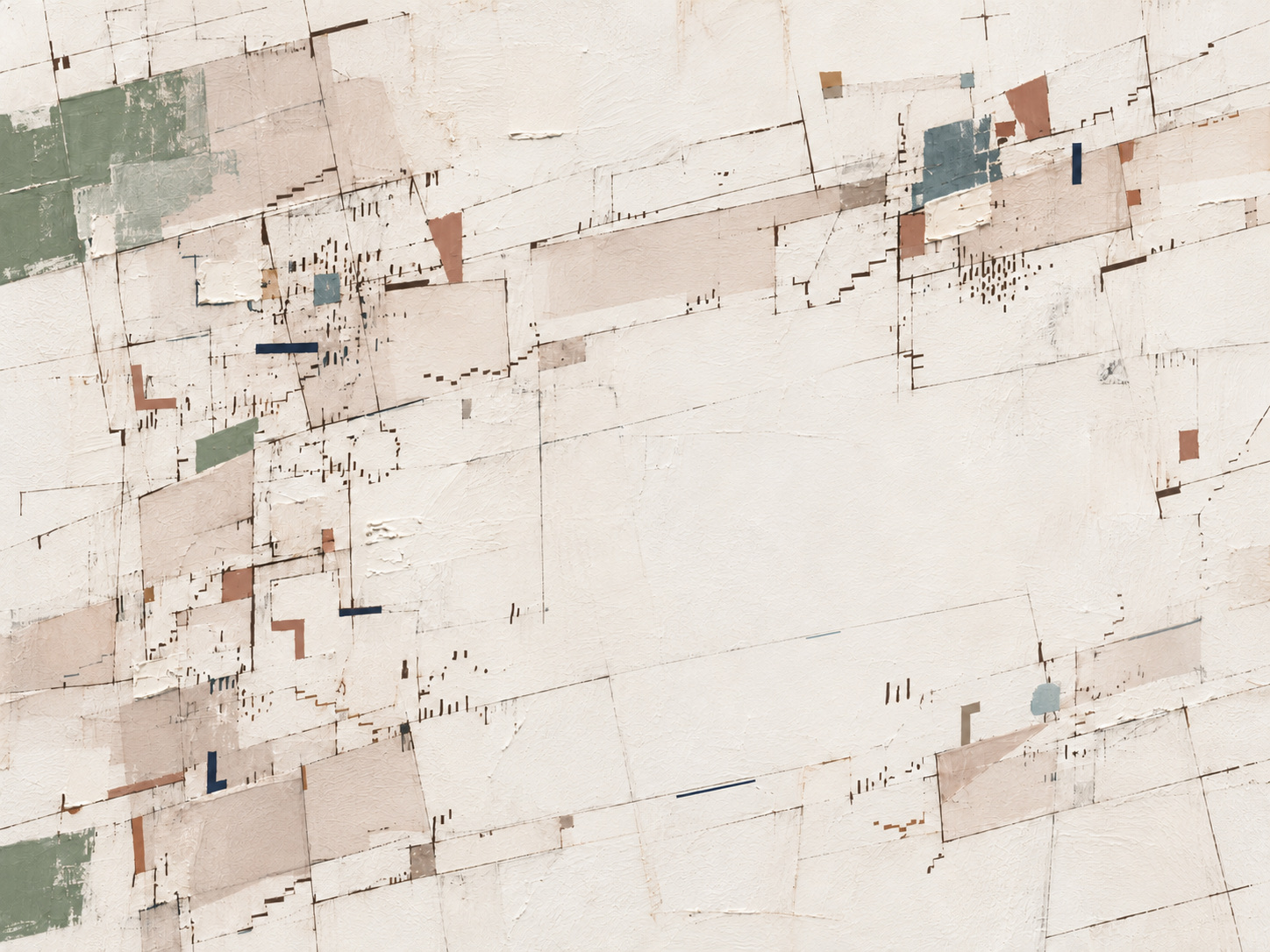
A framework stretches across the image. Some marks follow its lines; others gather beside them, cross a boundary or open another route. Small events change the character of the larger space. We can trace the structure and begin to imagine the lives unfolding within it.
An arrangement taking on a life
Pale planes give the drawing a loose sense of depth. Short bars, stepped lines and small clusters interrupt their edges. Some passages are densely occupied. Elsewhere, a line extends through an almost empty field, leaving room for the eye to move or settle.
These differences invite more than one reading. A cluster might suggest an encounter, a route becoming familiar or an activity gathering around a useful place. A gap might feel available, unfinished or simply quiet. The image leaves those possibilities open.
Following the small events
The fine drawing and the larger planes offer different ways to look. From a distance, we notice the arrangement. Closer attention brings forward the little adjustments: a line that stops, a mark that crosses another, a path that resumes slightly displaced.
The long open passage through the middle gives these details room. Dense areas hold our attention for a moment; small isolated marks invite it elsewhere. Returning to the whole, we may understand its balance differently.
What begins to happen once people make it their own?
References and making
This exploration grew from an encounter with Julie Mehretu’s Stadia II (2004), ink and acrylic on canvas, in the Carnegie Museum of Art collection. Its layered drawing, shifts in scale and simultaneous activity provided an artistic reference. View the museum record.
In the Whitney’s guide, Mehretu discusses the stadium as a gathering space and a structure for spectacle, with political meanings carried by its symbols. That context belongs to her work. The question about plans and everyday use developed here is AC’s interpretation. Hear the artist’s commentary.
This study was made with AI image generation from an original composition brief. Its ink, acrylic and textured surface qualities are digital interpretations. AC’s palette guides the color, with Sage in existing broad activity planes and Clay in local painted interventions, alongside the retained pale field and dark framework. The composition uses an angular framework and uneven concentrations of activity to explore the relationship between an arrangement and what might unfold within it.
Continue in the Index
Explore Designing for what people bring