About the work
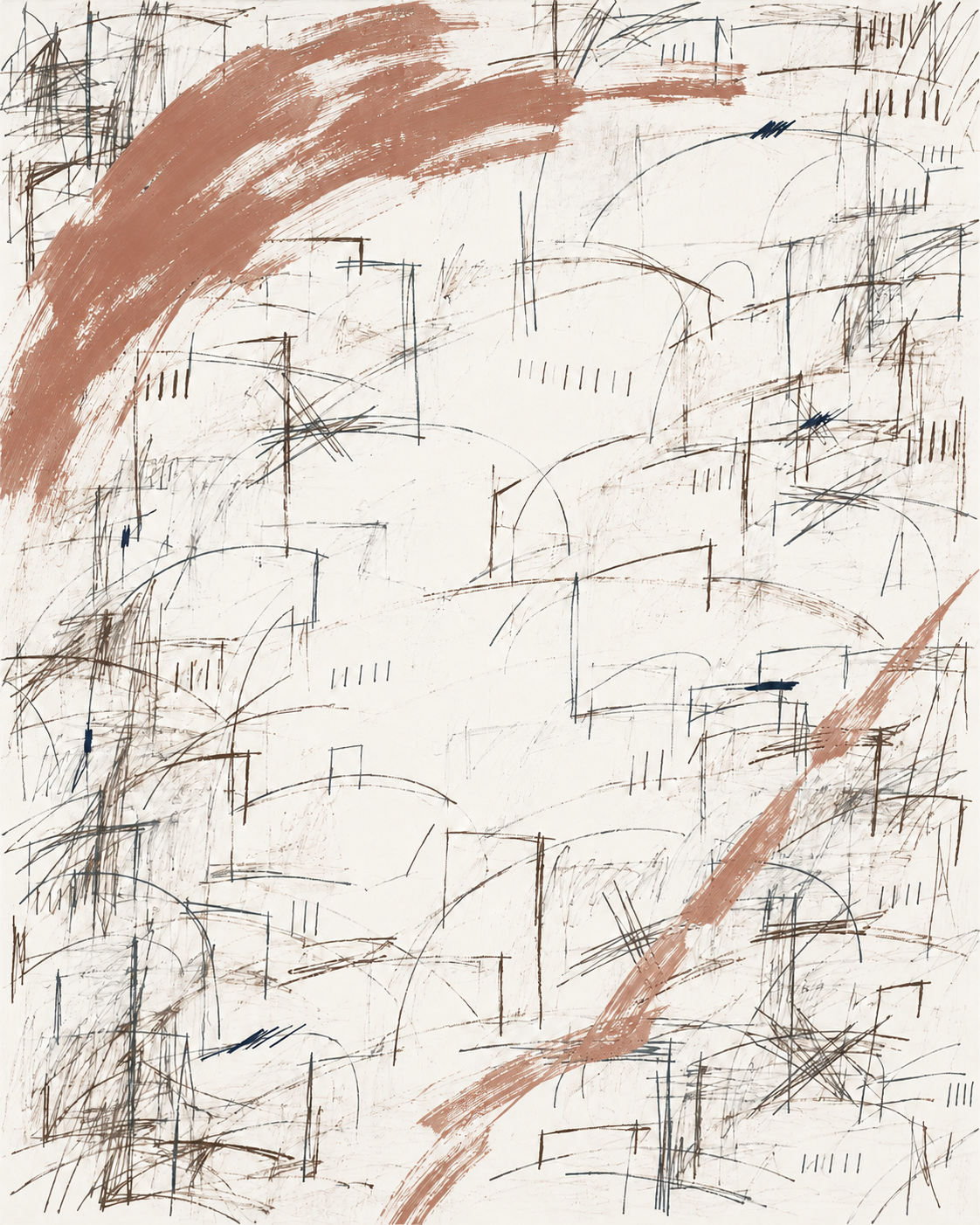
Fine Navy and Espresso marks gather into frames, crossings and dense local clusters. A line can suggest a corner, then continue beyond it. Short repeated strokes establish a small rhythm before the surrounding drawing pulls in another direction.
Clay carries a broader movement through the field. Its porous strokes pass across fine construction marks, leaving gaps through which the smaller decisions remain visible. Their scale changes the encounter: a local clue sits within a much broader movement across the page.
A direction still forming
The drawing gives us several places to begin. An opening can separate two groups or become a passage between them. A fragment that first appears isolated may gain significance when we follow a line elsewhere.
Finding our bearings can happen through these incomplete relationships. We recognize something, compare it with another cue, and revise where we think we are. The drawing keeps its references partial, with more than one route available.
That offers a connection with Abstraction’s work: attending to the clues already present, finding a useful reference, and allowing another observation to change the direction. Orientation can develop while the larger picture is still taking shape.
The line, pigment and worked-paper appearances are AI-assisted digital interpretations. Their different pressures, interruptions and intervals remain part of the inquiry.
Continue in the Index
Explore Creating a Sense of Orientation