About the work
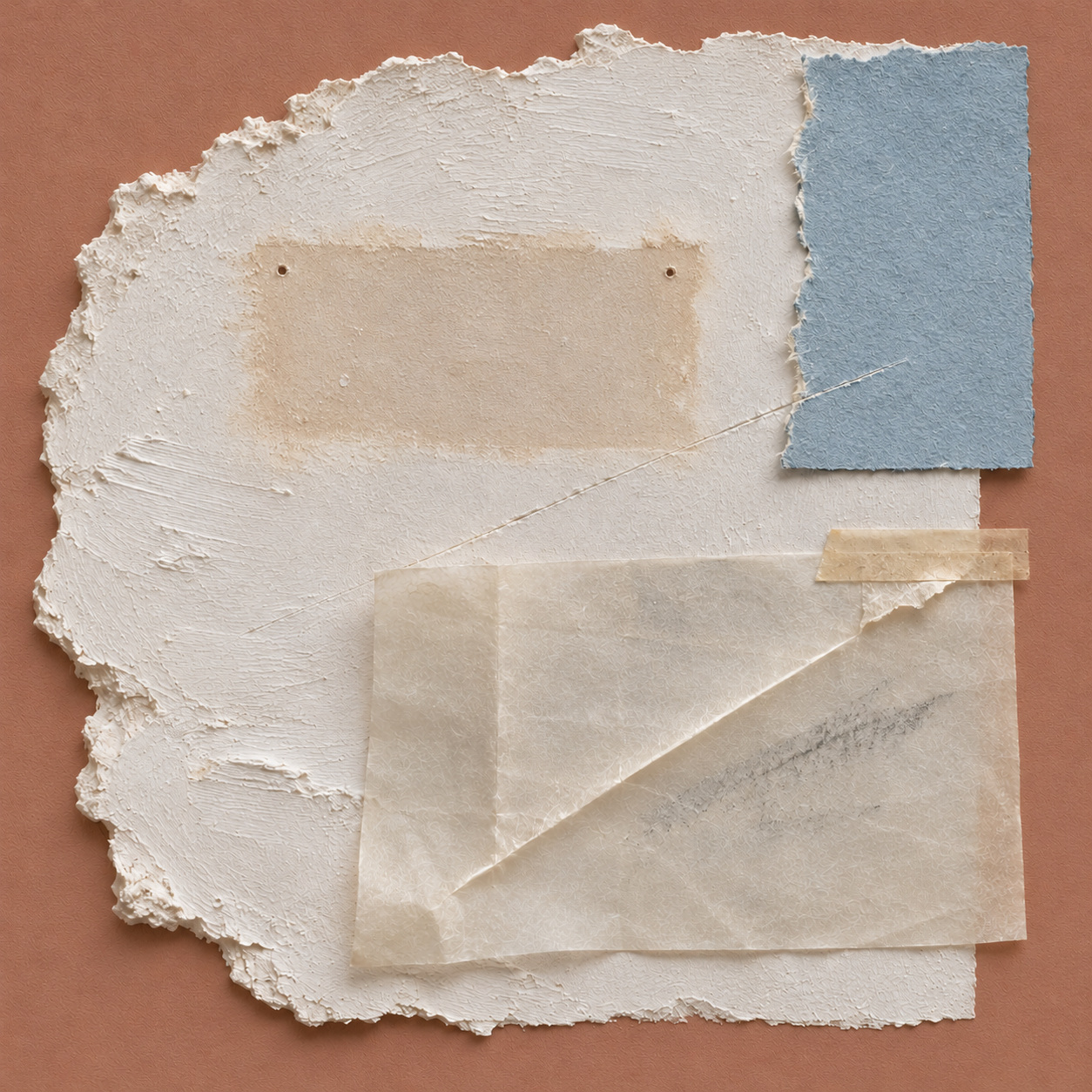
On a Clay field, a lighter edge outlines a rectangle. Two small holes remain. A fold runs through translucent paper, carrying a faint transferred mark. A Haze Blue fibrous layer introduces another surface on which to read a trace. Another line crosses the arrangement and meets a change of material.
We read these details as traces of something that happened: an attachment, pressure, handling, a covering removed. Their full story remains unavailable. Recognition gives us a starting point; the gaps invite us to consider what we are adding ourselves.
What Makes It Real? asks how evidence becomes understanding. Which marks do we trust? What do they allow us to infer? What might another encounter make us reconsider?
References and making
James W. Carey’s account of communication and symbolic reality provided a conceptual starting point. The inquiry into traces and how we revise an interpretation through further experience is AC’s development of that reading. Read A Cultural Approach to Communication.
Research also considered the relationship between object, image and definition in Joseph Kosuth’s One and Three Chairs (1965), and the arrangements of objects and images in Joseph Cornell’s assemblages and collages. Those references inform the questions around the work; this is an independent composition.
Created digitally with AI image generation, this arrangement uses plaster-like relief, torn paper, folds and adhesive traces as an artistic inquiry into evidence. It records no actual object, event or recovered history.
Continue in the Index
Explore When a promise becomes an experience