About the work
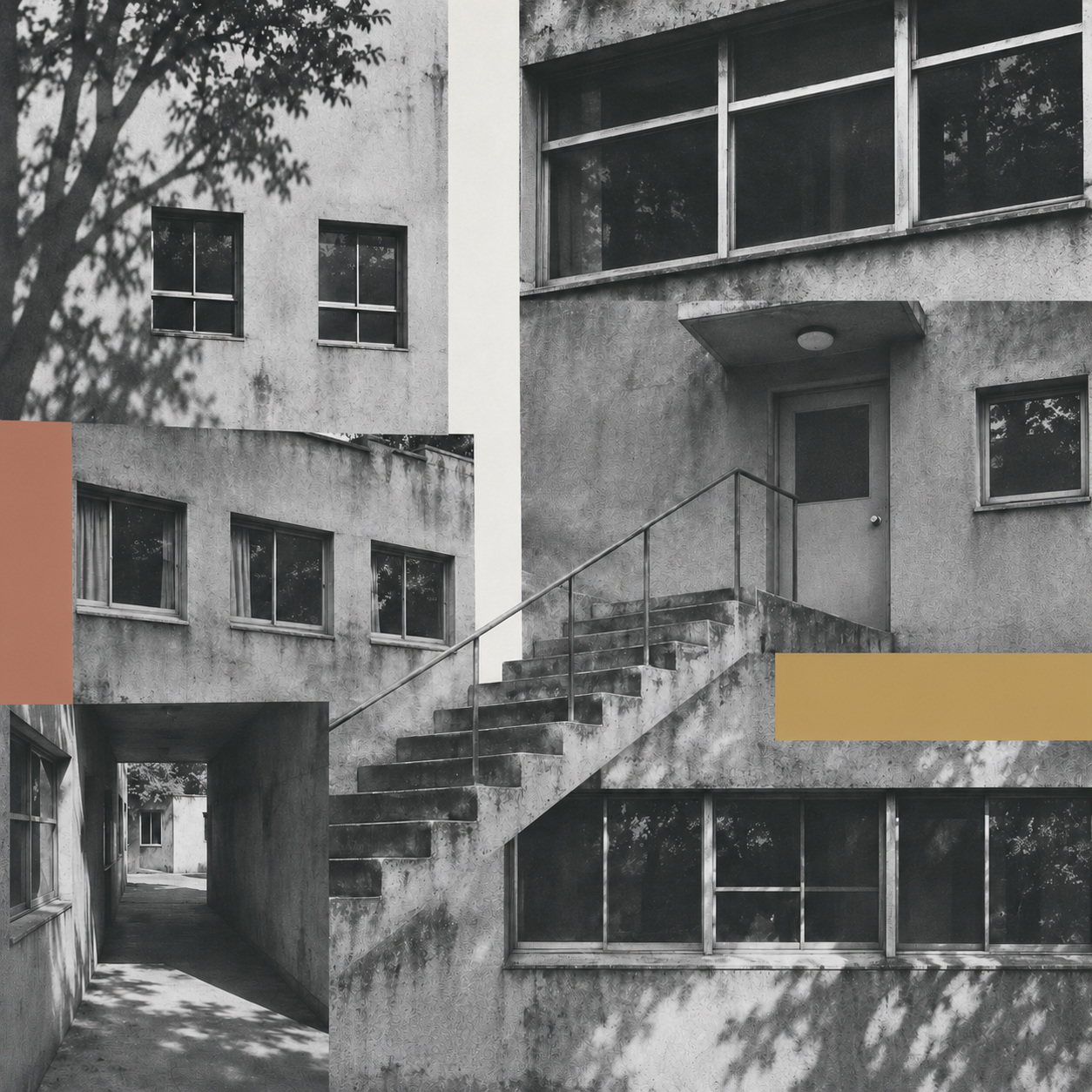
A stair reaches toward a doorway seen from another position. Window rows change scale at a straight join. A tree shadow remains convincing even where the surrounding elevation no longer forms a possible building.
Each fragment offers something familiar to follow. Their arrangement interrupts the connections that would usually help us find our way. A pale vertical interval opens between views, while Clay and Ochre printed insertions make two different contributions to the reconstructed surface.
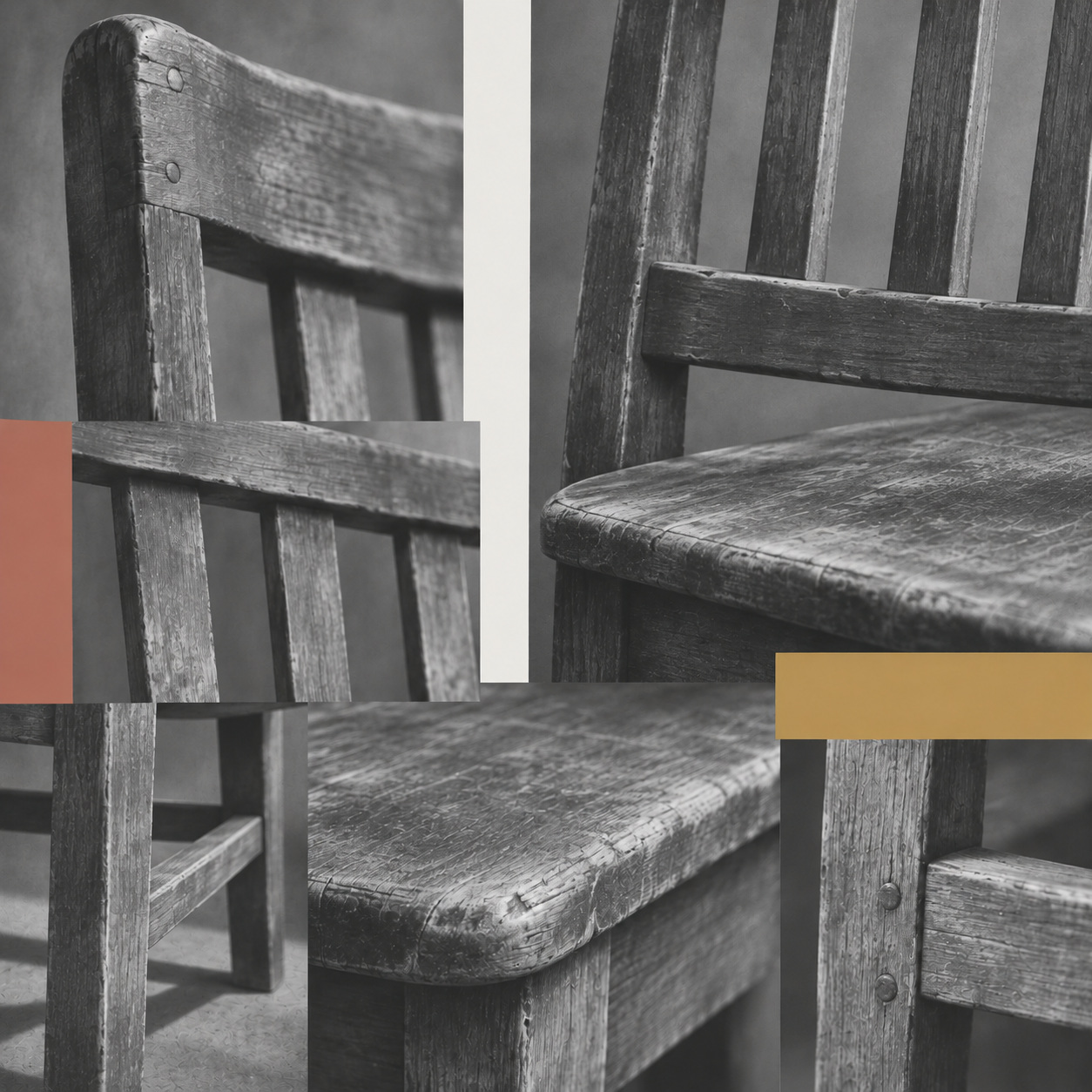
The chair companion carries this same logic into another recognizable subject. Portions of a back, a seat and supporting legs keep their local credibility while changes in scale and viewpoint interrupt the expected assembly. A small piece can be enough to suggest a familiar object.
Across the two versions, recognition becomes something we can examine at different scales. A convincing fragment can invite us into an arrangement that stays discontinuous. Following its grain, edge or shadow gives us one kind of understanding; trying to reconcile its neighbors gives us another.
A Different Kind of Familiar considers what survives when recognizable parts enter an unfamiliar relationship. We can move between the credibility of a single fragment and the discontinuity of the whole. Neither view quite settles the other.
The architectural and chair images are invented through an AI-assisted digital process. Both draw on photographic montage, using crop, scale, printed color and visible joins to keep their assembly perceptible.
Abstraction Creative, 2026 AI-assisted digital photographic montage
Chair version
A rounded upright, a row of back slats and the edge of a seat appear at different scales. Wood grain and small fastening marks give each fragment a convincing surface. Their rectangular boundaries make the changes in viewpoint visible.
The pale interval near the center interrupts what might otherwise be read as a continuous chair. A Clay insertion at the left and an Ochre strip toward the lower right add another kind of material voice. They sit within the assembly as printed color, distinct from the invented monochrome views.
Recognition arrives through parts: a seat edge, a leg meeting a rail, a familiar spacing between slats. Looking across their joins asks us to reconsider how those parts belong together. The chair remains available to the imagination while its expected relationships keep shifting.
This companion uses the architectural version's montage logic at the scale of an everyday object. Its wood, apparent wear and photographic detail are AI-assisted digital interpretations. Crop, scale and visible assembly carry the inquiry into what makes a familiar subject recognizable.
Continue in the Index
Explore What Carries Recognition