About the work
What is the thread between the things we remember?
A place can return to us through a voice. A phrase can gather a conversation around it. Something that seemed incidental can find its significance much later, beside another moment we could not have connected to it at the time.
The relationship becomes part of what we carry.
And is a small word with room for another thing. It can join without explaining the connection, continue without deciding where the story ends. Repeated, it becomes a rhythm: one thing and another, with an interval in which we might find ourselves.
What joining makes possible
A memory can have a presence of its own. Bring another alongside it and a different story becomes possible. The joining gives us something neither recollection held alone.
There is a choice in that act. Where do we begin? What do we place beside what? Which connections feel certain, and which are we still trying to understand? A life offers more than one way through its moments. The account we make of them has a shape, but it need not be the only shape they can take.
Writing gives that movement a visible form. A word occupies space. Another follows. We can return to a phrase, linger over it or notice a relationship we passed by before. Spoken language gives the same words another presence: breath, emphasis, hesitation, a voice we may continue to hear after it has fallen quiet.
That beauty matters here. Language can move us through its sound and gesture as well as through what it says. The hand and the pen belong to the thought taking form. A pause belongs to the telling.
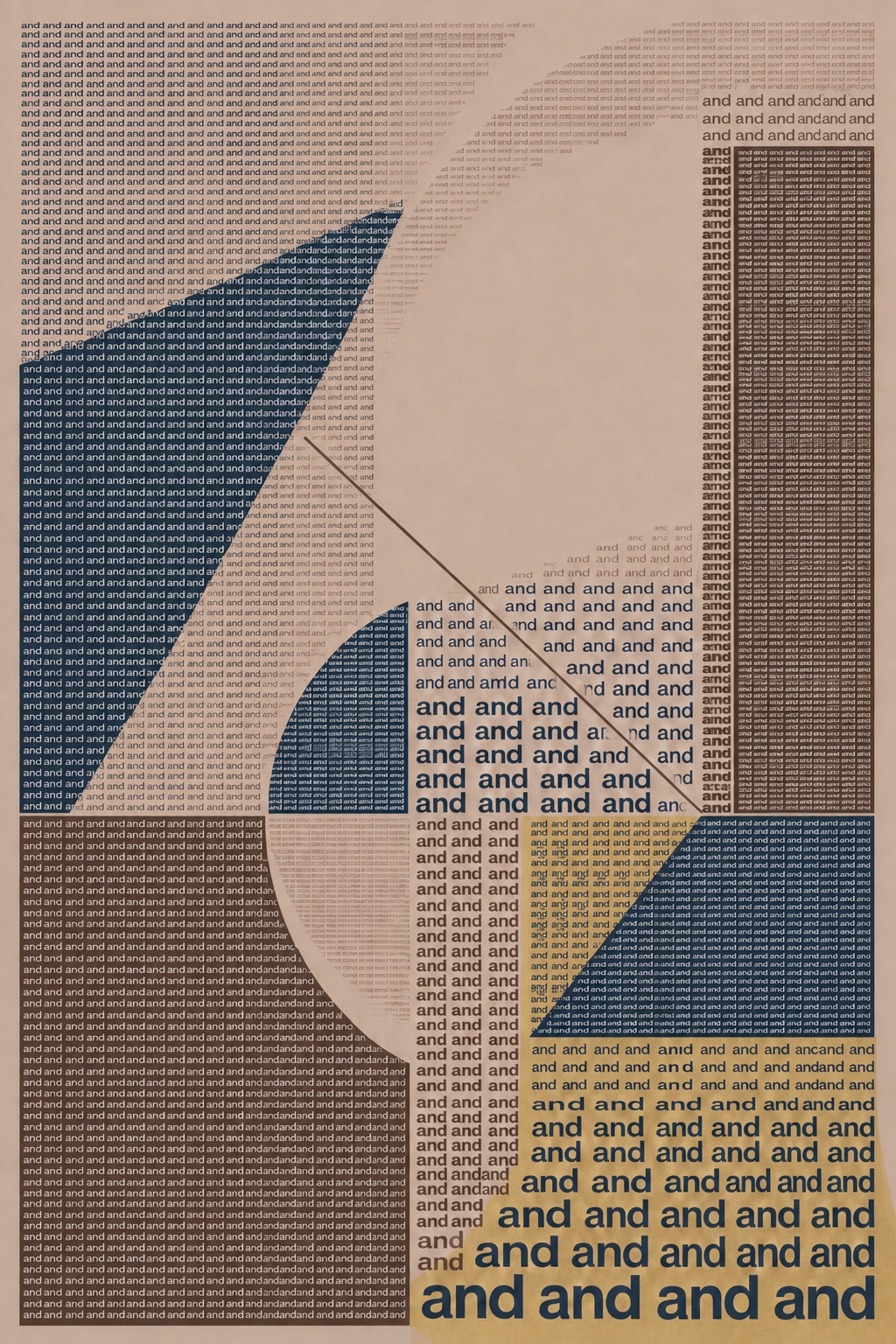
Across this work, a word can become texture and then become readable again. Its meaning remains available while other relationships gather around it. We might follow the repetition, the spaces it leaves or a connection that feels particular to us.
A word can also be encountered as a shape with weight, direction and a place among other shapes. The arrangement participates in its meaning. Move a word, open an interval or change the scale, and the relationship becomes different even while the word remains the same.
Joining does not require everything to agree. Two memories can belong in the same story and remain difficult to reconcile. Can the story hold together without making them agree? An unresolved moment need not be made tidy to deserve a place. Nor does every silence need to be filled.
An and can also be an opening for someone else to add a detail, bring a memory of their own or take the conversation somewhere we could not have reached alone. The story remains open to a voice other than the one that began it.
A story takes shape in what we join, and stays open to what comes next.
The connections you make need not be the ones that began the work. Something in its rhythm may call up an association no one else could have supplied. That meaning can remain yours.
Where the idea began
This work grew from Avery Potter's encounter with Bouthayna Al Muftah's Untitled (2025) at LACMA. What stayed with him was the writing and its significance, the hand and pen, and the beauty language can have when visualized.
In conversation, and and and became a way of thinking about “stitching memories together to create the larger narrative.” That recollection shaped the response: joining itself could carry the work, leaving the story open rather than giving every mark an explanation.
The composition also carries the abstract and Constructivist influences at the foundation of Abstraction Creative. Here, language is both meaning and material. Structure and expressive irregularity act on one another, giving the work form without settling every relationship within it.
Continue in the Index
Explore And and and