Empathy is the practiced effort to understand another person's experience—their needs, circumstances, perspective, and feelings—and allow that understanding to influence how we respond.
At Abstraction Creative, it means paying enough attention that someone's needs can change what we make.
We see empathy as central to design. Without it, we may become very good at expressing our own ideas while missing the people those ideas are meant to serve.
There is no meaningful design without empathy.
That is a responsibility we ask of our whole team, not a quality assigned to one person or one stage of a project.
The person changes the question
A person can arrive in a brief as a category: customer, employee, visitor, client, user. Those words help us organize the work, but they tell us very little about a particular experience.
What is someone trying to do? What do they already know? What else is happening around them? What are they worried about, looking forward to, or tired of having to explain?
The answer can change a design decision. Something that feels straightforward to a team familiar with its own product may ask a great deal of someone encountering it for the first time. A step that appears unnecessary may help a person feel confident before making a commitment.
Empathy gives those circumstances room to matter. It makes us less comfortable dismissing confusion as a user's failure or treating a repeated question as an inconvenience.
That influence should be visible in a decision. We may change the order in which a task unfolds, the language that introduces it, the amount of information someone encounters at once, or the support available when something goes wrong. We can explain what we learned and how it affected our recommendation.
Sometimes a need leads us to question the proposed solution. A request for fewer steps may reveal that someone needs a clearer sense of progress. We can explore that together, make alternatives tangible, and let the person help us judge the response. Our responsibility is to use what we understand with care, including where needs pull in different directions.
Listen for more than the requested solution
Someone may tell us they need a new page, a different tool, or a more confident-looking brand. We take that request seriously and want to understand the experience behind it.
What prompted it? When does the current approach let them down? What are they hoping the change would make possible?
A useful follow-up grows from what was just said. Sometimes the detail comes through an ordinary conversation: an explanation of a routine, a small frustration, a workaround that has become normal. Listening gives those details a chance to change our understanding.
It also requires restraint. We do not need someone to share a painful story to justify taking their needs seriously. They should be able to decide what they want to disclose and how they want to participate.
Understanding is something we work toward
Empathy is not a claim that we know exactly how someone feels. Our own experience may help us connect, but it can also make us assume too much.
We need to distinguish what a person told us, what we observed, and what we inferred. Different people may experience the same design differently. Someone's stated preference may not fully describe what happens when they use the product.
Conversation, observation, research, and feedback help us examine those differences. Stakeholder knowledge is valuable, while the people using a product may offer a perspective that the organization has not heard. When specialist research or testing would help, we can bring that expertise into the work.
We remain open to being corrected. Feeling certain that we understand is not the same as having understood enough to make a responsible decision.
Anticipating what someone may need
People do not always know which design change would help them. They may describe the difficulty rather than a possible response, or have learned to tolerate something they no longer think to mention.
Design asks us to bring imagination to that understanding. What could make this easier to approach? What would help someone feel prepared? Where might an explanation, an alternative, or a way to recover make a difference?
Anticipation is an informed proposal, not permission to decide on someone's behalf. We can make a response tangible, invite feedback, and learn whether it serves the need we thought we recognized.
The ambition is an experience that feels considered before someone has to ask for consideration.
The notebook beside the screen
When a team uses handwritten notes alongside shared software, we ask what the notebook is doing for the person. We do not begin by treating a familiar way of working as resistance to change.
We can walk through a customer call with the team and examine where information is needed. Does entering a note take someone away from the record they are discussing? Is it clear when a draft becomes visible to colleagues? What happens to an unfinished thought when another task interrupts?
Each answer can suggest a different response. Keeping relevant information in view, distinguishing private drafts from shared records, or improving how unfinished work is retained may matter more than asking everyone to follow a new rule.
The notebook may also do something worth preserving. Together, we examine what should move into the system, what can stay outside it and where a handoff needs more care. We then make the proposed changes tangible enough for people to question.
Understanding the person changes how we approach the product and how the organization discusses the difficulty. The customer on the call matters too: their conversation depends on the attention of the person helping them.
Care can take a form
An experience can express care without displaying an obvious symbol of it.
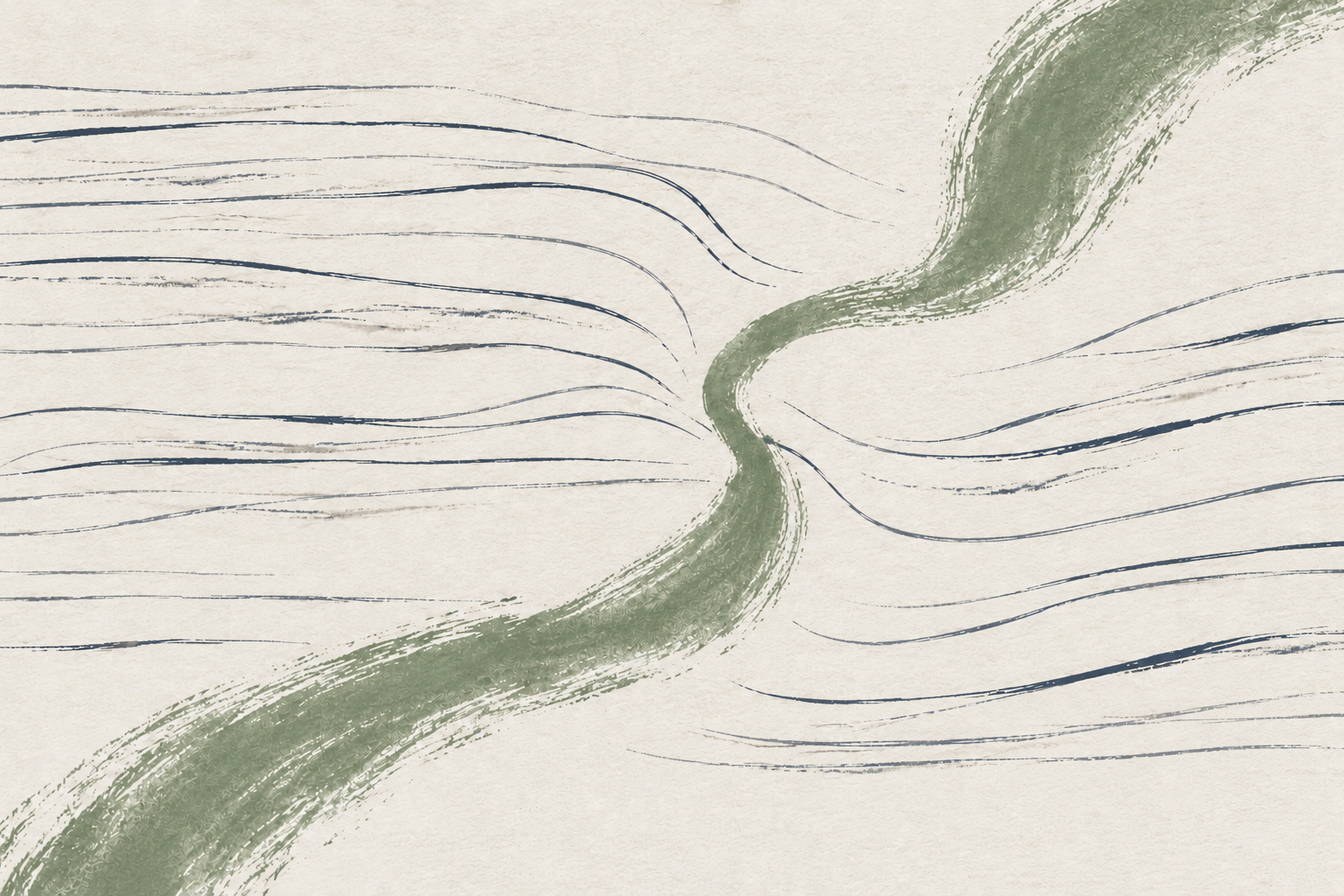
In the Empathy drawing, fine Navy lines establish a rhythm and then alter their direction and spacing near a broad Sage gesture. The two kinds of mark keep their distinct character. The encounter offers a way to consider what it means for another presence to affect how we proceed.
That question connects the drawing to our practice. A person's circumstances can change the question we ask, the priority we set, or the form a response takes. We want the work to show the consequence of paying attention: something about the experience becomes different because we understood more of the person.
A sentence can acknowledge uncertainty without speaking down to someone. A visual hierarchy can help them find what matters. An interface can preserve the effort they have already made. A space can give them a way to orient themselves without having to ask. A support process can keep them from repeating the same explanation to each new person.
These are decisions about language, composition, behavior, operations, and the environment. They connect Empathy to Content Design, UI/UX, Branding, Architectural Design, and Service Design.
Care is also present in what we choose not to do: pressure someone, obscure an important detail, expose information unnecessarily, or use a vulnerability to encourage a decision they might otherwise reject.
Recognizing an emotion gives us a responsibility toward the person experiencing it. It does not give us permission to exploit it.
Design as an expression of love
For us, there is room to think of design as an expression of love: the feeling that another person's experience matters enough to move us to act.
Hearing what someone is trying to accomplish can make the work feel personal before a method or a scope has been chosen. We want to help because we have begun to understand what is at stake for them.
That feeling needs thoughtful practice around it.
Wanting to help does not tell us what would help. Questions, evidence, imagination, and honest conversation give the impulse somewhere useful to go.
Care may lead us to invest more attention in a detail. It may also mean recommending less, challenging an idea, or admitting that we do not yet know. A generous intention should leave the other person with more understanding and agency, not an obligation to agree with us.
Empathy belongs in the collaboration, too
Your experience of working with Abstraction matters. So do the experiences of the people on our team and the specialists we collaborate with.
We want to understand the constraints around a project: what the business is carrying, where decisions are difficult, and what different people need in order to contribute. Clear explanations, realistic commitments, and respect for each other's expertise help that understanding become a working relationship.
We encourage co-creation without expecting clients to become full-time participants. There are different ways to contribute knowledge and learn through the process. Our responsibility for judgment and communication does not disappear when your attention is needed elsewhere.
Taking your success seriously also means being honest about uncertainty, scope, time, and what we can responsibly promise. Care is a reason to have those conversations clearly.
Keep listening as things change
Empathy is central to Design Thinking, but we do not leave it behind after an early discovery exercise.
In Define, it influences which needs take priority. In Explore, it challenges us to consider responses beyond our own preferences. In Design, Development, and Marketing, it shapes the choices people will encounter. In Learn and Advance, it asks us to pay attention to what those choices actually meant for them.
Discover → Define → Explore → Design / Develop / Market → Learn → Advance → Discover
The understanding returns to Discover. People change, businesses change, and a once-useful response can become something that needs another look.
An ongoing relationship gives us opportunities to keep learning together. Its value is not that we eventually know everything about someone. It is that we remain willing to listen and let what we learn change the work.
Try it: notice what you have assumed
Choose a moment when someone did something you did not expect. Before explaining why, separate three things:
- What did you actually see or hear?
- What meaning did you give it?
- What could you ask or observe to understand it better?
If you can ask the person, invite their account without building your explanation into the question. “Can you walk me through what happened?” leaves more room than a question that already assumes confusion, resistance, or a mistake.
The exercise is an invitation to learn, not a substitute for research or proof that we now understand the whole experience.
What would you like us to understand?
Bring us the ambition, frustration, question, or situation behind the project. We do not need it to arrive as a polished brief.
We will listen, ask, and work with you to understand what could help. The things you tell us may change the design. That is part of why the conversation matters.
Return to the Gallery
Encounter Empathy in the Gallery