The conditions around something are part of its design.
A material is encountered in particular light. A website is used on a particular device, by someone with a task and a limited amount of attention. A campaign reaches people with expectations shaped by earlier experiences. Those circumstances belong in the work from the beginning.
Conditions also change through the decisions we make. Choosing a platform influences what a team can publish and maintain. Reorganizing a space changes how people arrive, move and spend time. Introducing a service creates new expectations for the systems and people delivering it.
At Abstraction Creative, we explore those relationships across Architectural Design, Branding, Digital Design, Digital Development and Marketing. Understanding what a choice makes possible includes considering what it asks of everything connected to it.
Our three studies in Under Changing Conditions offer different ways into that inquiry: noticing the surrounding conditions, following an adjustment through neighboring parts, and reconsidering how the parts might work together.
Notice what surrounds the work
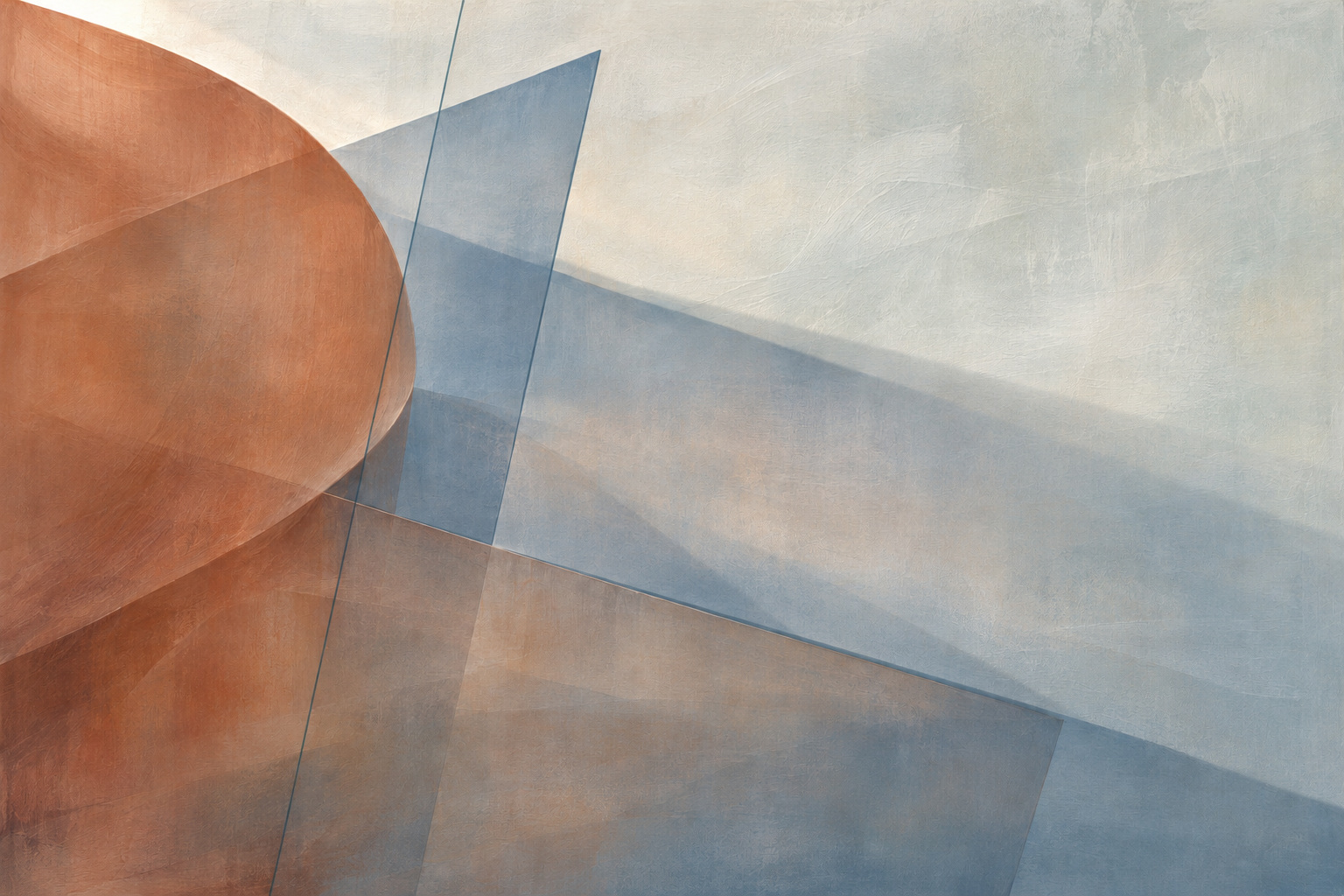
Light across a shared field. The first study makes illumination and overlap part of how we read a form.
The first image makes light's passage explicit. Its translucent layers and open field give the surrounding illumination a visible role. We can recognize a similar question in practical work: what circumstances are shaping this encounter?
For a digital experience, that may involve a person's immediate task, device, connection, accessibility needs or familiarity with the subject. For a physical place, it may involve daylight, shade, sound, materials, movement and the surrounding landscape. For a message, it includes what someone already understands and what they need in order to act.
A persona, journey map or plan can help us organize what we know. Encounters with particular people and places continue to develop that understanding. An unexpected response can reveal a condition we had overlooked or an assumption worth revisiting.
Follow a change beyond its starting point
A shift carried through the layers. Registration marks, lifted edges and interruptions suggest an adjustment with effects beyond a single piece.
The second study draws attention to where materials meet. A small difference in position becomes apparent through an edge, a shadow or a mark on an adjoining layer. It gives us a way to consider how a decision travels through connected work.
Imagine a launch date moves forward. An existing platform might offer a useful route to releasing the experience. Its capabilities could then shape content structure, interaction choices and the destination a campaign can promise. The team responsible for publishing, responding to inquiries and maintaining the system needs a place in that conversation.
Tracing those relationships can reveal opportunities as well as responsibilities. A simpler content structure might make updates easier. A well-chosen integration might remove repeated data entry. A working prototype might uncover a useful interaction before the full system is built. Technical judgment can help an expressive idea become achievable and useful.
The same attention belongs in architectural work. A change to an opening can affect light, shade, material choices, artwork placement and circulation. Understanding those relationships helps us consider the experience of the place as a whole.
Reconsider the arrangement
Combined deconstructivist study. Familiar elements from the first two works acquire new neighbors, openings and points of contact.
The combined image changes the relationship between the first two. Transparent curves pass through opaque planes; interrupted marks and an opening make the joins visible. Elements remain recognizable while their roles in the composition change.
For our practice, this opens a question about inherited arrangements. A website's navigation may reflect the organization that built it. A workflow may retain steps introduced for an earlier tool. A brand may rely on expressions that once carried its identity particularly well. We can examine what those arrangements still contribute and where another relationship could serve the present purpose.
Branding asks what carries recognition as language, imagery and behavior develop. Digital Design considers how information and interaction support different tasks. Digital Development connects the experience with content, records, integrations and ongoing care. Marketing follows the relationship between an invitation, a response and the experience that follows. Architectural Design considers how people occupy and move through the resulting place.
Bringing those contributions together gives us new questions to examine. Does the arrangement help people accomplish what matters? Can the team understand and maintain it? What becomes clearer, and what now needs attention? The combined study remains one possibility alongside the two works that informed it; each offers a different experience.
Let different perspectives develop
Differences of opinion can bring valuable information into a shared undertaking. Someone may notice an expressive possibility, another a difficulty in everyday use, another an assumption that has gone unexamined. Listening can broaden our own understanding and give others room to develop theirs.
A sketch, prototype, sample or conversation gives those perspectives something shared to respond to. People can ask what another person is seeing, explain the conditions behind a preference, and discover a possibility through the exchange. A decision can move the work forward while useful differences remain visible.
That invitation extends beyond a particular role or meeting. Each of us can consider where we make room, whose experience we have yet to understand, and what we might be willing to reconsider.
Carry the reasoning forward
A decision record can preserve the circumstances behind a choice: what mattered, what was considered, who contributed, and what would be worth revisiting. As conditions change, that reasoning gives future work a useful starting point.
Maintenance, adaptation and continued learning are part of this relationship. A new capability may change how a system is used. A campaign may reveal an unexpected need. Experience of a place may suggest a different arrangement. We can return to the work with a clearer sense of what to preserve and what to explore next.
What does this decision make possible, and what does it ask of everything connected to it?
The architectural starting point
This exploration began with the experience of Frank Gehry's Fondation Louis Vuitton in Paris. The building's account describes an architecture responsive to time and light; T/E/S/S explains how the glass sails also shelter terraces and reduce solar gain. Daniel Buren's Observatory of Light offered a further reference for how a change to the glass could alter the experience of the building. The building, the engineering, and Buren's installation.
The connections to AC's practice are our interpretations. The three images are original AI-generated digital studies; the paper, acrylic, graphite and glazing qualities are digitally interpreted. The opening pull quote is original AC working language developed through this exploration.
Return to the Gallery
Encounter Under Changing Conditions in the Gallery