A question can look different when we change the scale at which we examine it. A whole experience may seem coherent while one interaction remains difficult. A small adjustment may appear successful while creating another problem elsewhere.
We can move between these scales deliberately. At the wider view, we ask what people are trying to accomplish and how the parts connect. At a closer view, we can examine a particular piece of information, a transition or a decision someone needs to make. Each view helps us interpret the other.
Move between a whole visit and one decision
Consider a venue trying to make its programme easier to explore. A broad map of the visit may show a sensible sequence from discovering an event to receiving practical arrival information. Closer examination of one listing may reveal that the date, location or next action is difficult to distinguish.
Both views can be useful. The wider sequence helps the team decide which encounters should connect. The individual page lets us examine the language, hierarchy and information involved in a particular choice. A change that looks convincing in an isolated screen can then be returned to the route it belongs to.
We could compare several representations with the client: a simple journey, a group of event examples and a working interaction. Each answers a different question. There is little value in refining a detailed screen if the team is still deciding what the page needs to do; a broad diagram may be insufficient once a small interaction determines whether someone can continue.
Moving between these forms helps make the next decision proportionate to what we know. The client can understand why more detail is being introduced, what it allows us to examine and which larger purpose the detail is intended to serve.
Choose detail in relation to the question
The appropriate level of detail depends on the question. A broad map may be enough to compare possible structures. A working prototype may be needed to understand a specific interaction. Adding detail becomes useful when it helps us make a consequential distinction.
At Abstraction, we can use these different representations to keep a project understandable as it develops. We can return from a local finding to the wider purpose, then choose where closer attention is needed next. This helps prevent a familiar overview from concealing an important detail, or a compelling detail from taking over the whole discussion.
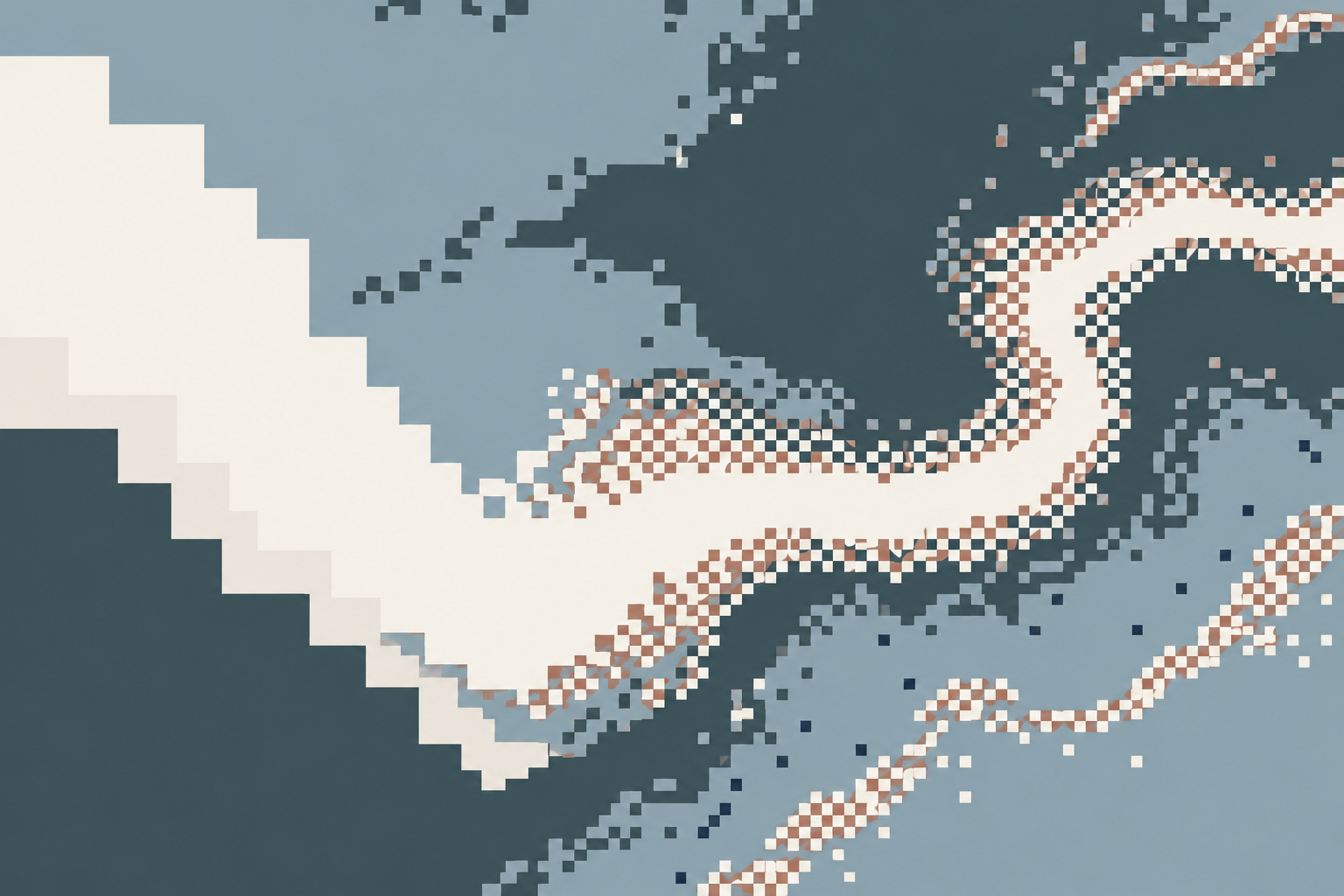
A Different Resolution places large silhouettes beside finer square units. The pale channel connects both scales, offering a way to consider what remains visible as the level of attention changes.
Return to the Gallery
Encounter A Different Resolution in the Gallery