The way we describe a problem establishes where we begin looking. It directs attention toward particular obstacles, people and possible changes. Revisiting that frame can reveal a relationship that an earlier description left outside the discussion.
We can begin with a concrete point of difficulty. What is someone trying to do, and where does the experience become hard to continue? Looking from another position may reveal that the visible problem depends on an earlier decision, a missing connection or an assumption about how the work should happen.
Examine the difficulty from another position
Consider an arts centre receiving repeated questions about where an evening event takes place. A first response might be to add more signs. That may help, but we can also follow the visit from the invitation to the entrance and ask what each person has been led to expect.
The event listing might use one room name while the confirmation uses another. A regular visitor may recognize an informal name that a first-time visitor has never encountered. The person welcoming people may know an alternative route that the online information does not describe. Each account adds another position from which to examine the difficulty.
We could map that sequence with the team and make several possible responses tangible. One may change naming, another the arrival message, another a cue in the space. Comparing them can show whether the original problem description is sufficiently useful or whether an earlier connection deserves attention.
The client helps us assess what fits the setting and what can be maintained. A new frame earns its place by explaining the situation more clearly and suggesting a response worth examining. It remains open to correction through what people actually encounter.
Compare readings against the situation
This does not require treating every interpretation as equally useful. We can compare them against the situation and the people involved. A different view becomes valuable when it helps explain something specific or gives us a more workable question to examine.
At Abstraction, drawing, mapping and prototyping can help make those views comparable. A change in sequence can reveal a new route. A different arrangement can expose a relationship between parts that had been discussed separately. We can then test whether the revised understanding holds in use.
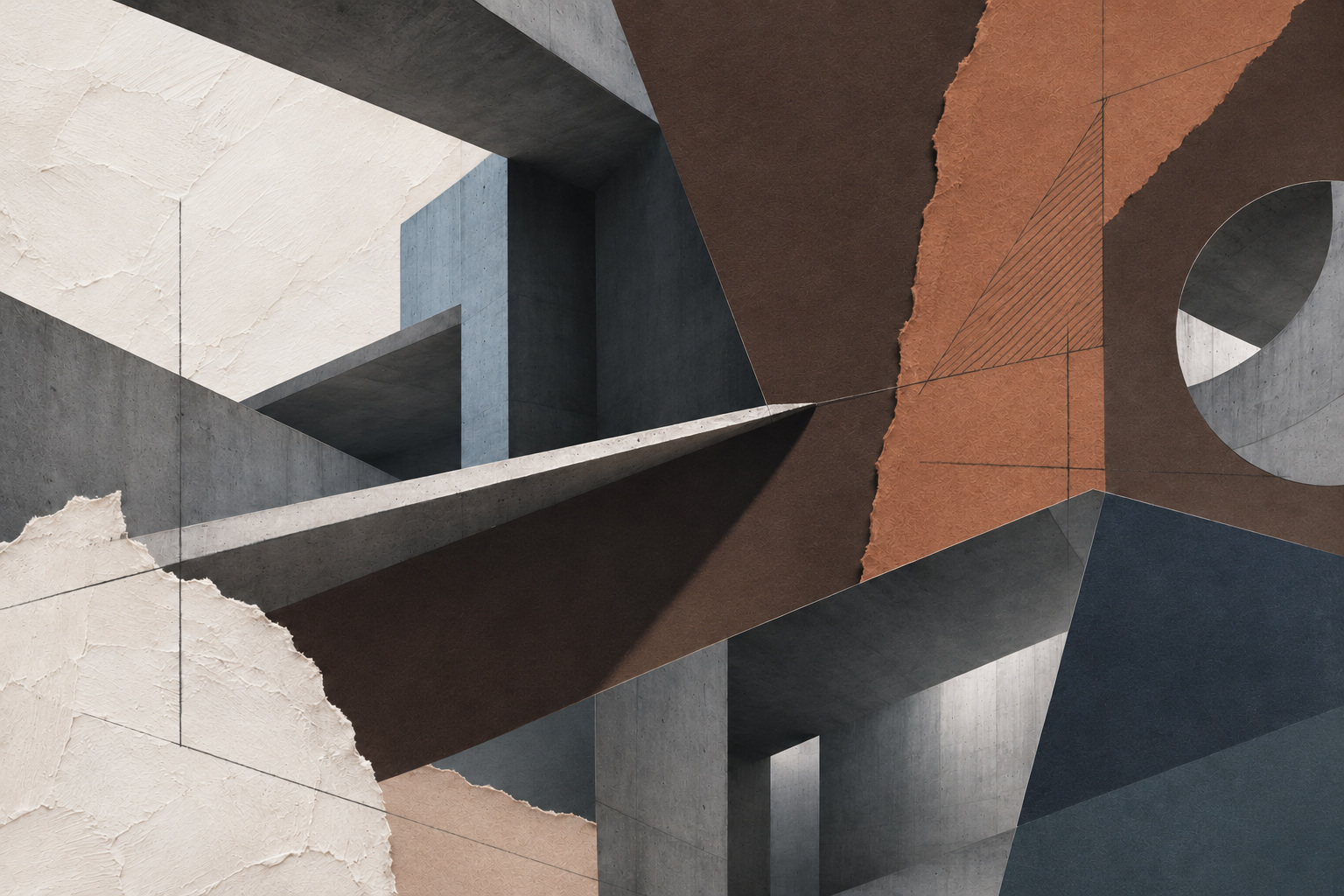
Between Forms gives a spatial expression to this movement. Its ledges, openings and flat marks change roles as attention moves through the image. The encounter encourages us to consider how much of a difficulty belongs to the thing itself, and how much belongs to the position from which we first approached it.
Return to the Gallery
Encounter Between Forms in the Gallery