A few seconds of music can stay with us long after a record ends. We return to a phrase, a pause, a feeling we cannot quite explain. Sometimes, someone hears another possibility in that moment—and gives it a new life.
The relationship between Ahmad Jamal's I Love Music and Nas's The World Is Yours, produced by Pete Rock, gives us a way to think about that possibility. About listening closely, recognizing something worth exploring, and discovering what can happen when different voices meet.
Listening for possibility
Pete Rock drew a brief piano passage from Ahmad Jamal's I Love Music into the foundation of The World Is Yours. In his account of making the track, he describes repeatedly listening to the loop, initially without drums, and responding to the nostalgia it evoked. Nas's writing and performance, Rock's production and their contributions to the hook brought that passage into another work. Read Pete Rock's account.
For us, part of the fascination is the attention behind the choice. Within a complete performance, a short passage becomes the beginning of a different composition. Its surroundings change. So does the way we encounter it.
Jamal's recording remains a work with its own life and character. The new record does not erase that. Knowing the connection gives us another reason to listen to both.
What context makes possible
The same detail can feel different depending on what surrounds it. A pause can create anticipation or offer relief. Repetition can bring a quiet element into focus. A voice can introduce a perspective that changes how we hear everything beneath it.
That relationship between a part and its setting matters in design, too. A sentence can become the center of a brand's expression. A gesture can suggest how an interface should respond. A material can begin a conversation about how a place ought to feel. None of those starting points tells us the complete answer. Each gives us something to explore.
We look closely at why a detail matters, who it matters to, and what happens when we try it in another form. Sometimes it becomes central to the work. Sometimes it leads us somewhere unexpected and is eventually left behind. Both can be useful discoveries.
An idea does not have to arrive fully formed. It needs enough attention to reveal what is worth exploring, and room for other people to help it grow.
Giving the idea visible form
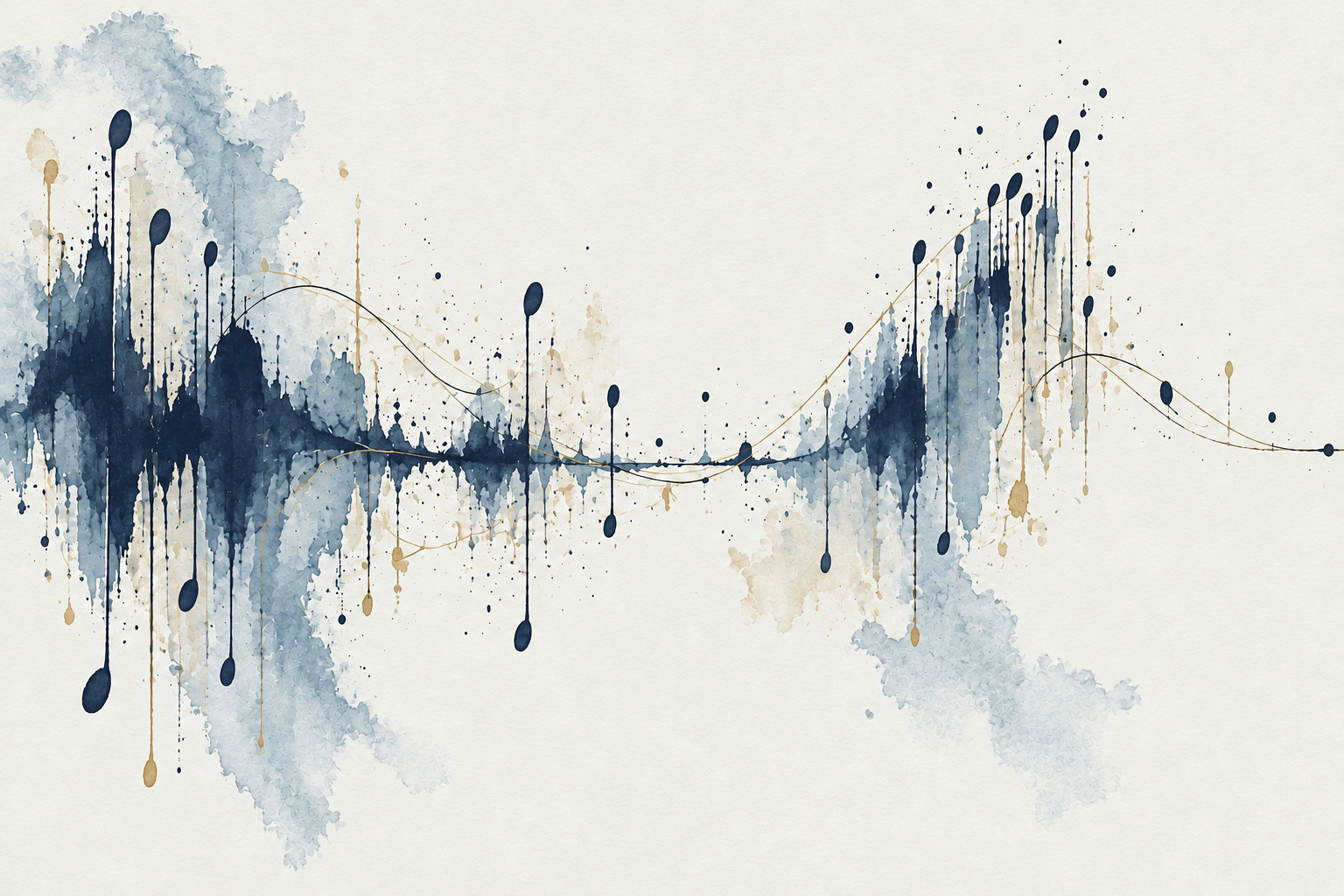
The artwork explores this relationship through marks that move between sound, notation and image. Waveform-like passages gather into dense fields, then open into quieter spaces. Note-like forms suggest individual moments within that movement. Fine lines carry the eye between them.
The waveform suggests something felt. The notes reveal parts and relationships. Their arrangement invites us to consider how those parts might be reconsidered and shaped into something new.
This is an artistic interpretation of the idea. It invites a kind of visual listening: noticing a rhythm, following a line, returning to a detail. You do not need to read music or recognize the records to find your own way into it.
The artwork becomes a way into the thinking.
Shaping something together
In our work with people, a beginning is often just as open. Someone brings an ambition, a reference, a frustration, or a sense that something could be different. We ask questions to understand what sits behind it. What are they responding to? What have they already learned? What might the people they hope to reach experience differently?
Then we give those questions form. We might sketch a direction, try different language, explore a material or build something people can interact with. Having something to respond to changes the conversation. A client sees a possibility they had struggled to describe. Someone else notices a problem we had missed. The next version carries that understanding forward.
For a small music venue, a sentence a host uses to welcome first-time visitors might become a starting point for an invitation. We could try it beside different images and practical event information, then ask the venue team and prospective visitors what they understand. The phrase may help express a character already present in the room. It may also need to change once people ask about timing, access or what to expect. The venue's knowledge and those responses would shape the next direction.
This is why co-creation matters to us. People bring different knowledge, experiences and instincts. Working together helps us discover relationships that would be difficult to reach alone—and gives everyone a clearer understanding of why the work is taking the shape it does.
Design Thinking helps us explore those possibilities in relation to real needs. Art Direction helps us make deliberate choices about their expression. The process creates opportunities to learn, question and make something people feel proud to stand behind.
Something to begin with
Perhaps there is an idea you keep returning to. A detail you notice that other people seem to pass over. Something you know could be better, even if you cannot yet explain what it should become.
Bring that into the conversation. We can start by listening.
Listen to the connection
Both works deserve a listen in their own right. Hearing them together adds another way to appreciate the connection.
Return to the Gallery
Encounter A Fragment Becomes a World in the Gallery