About the work
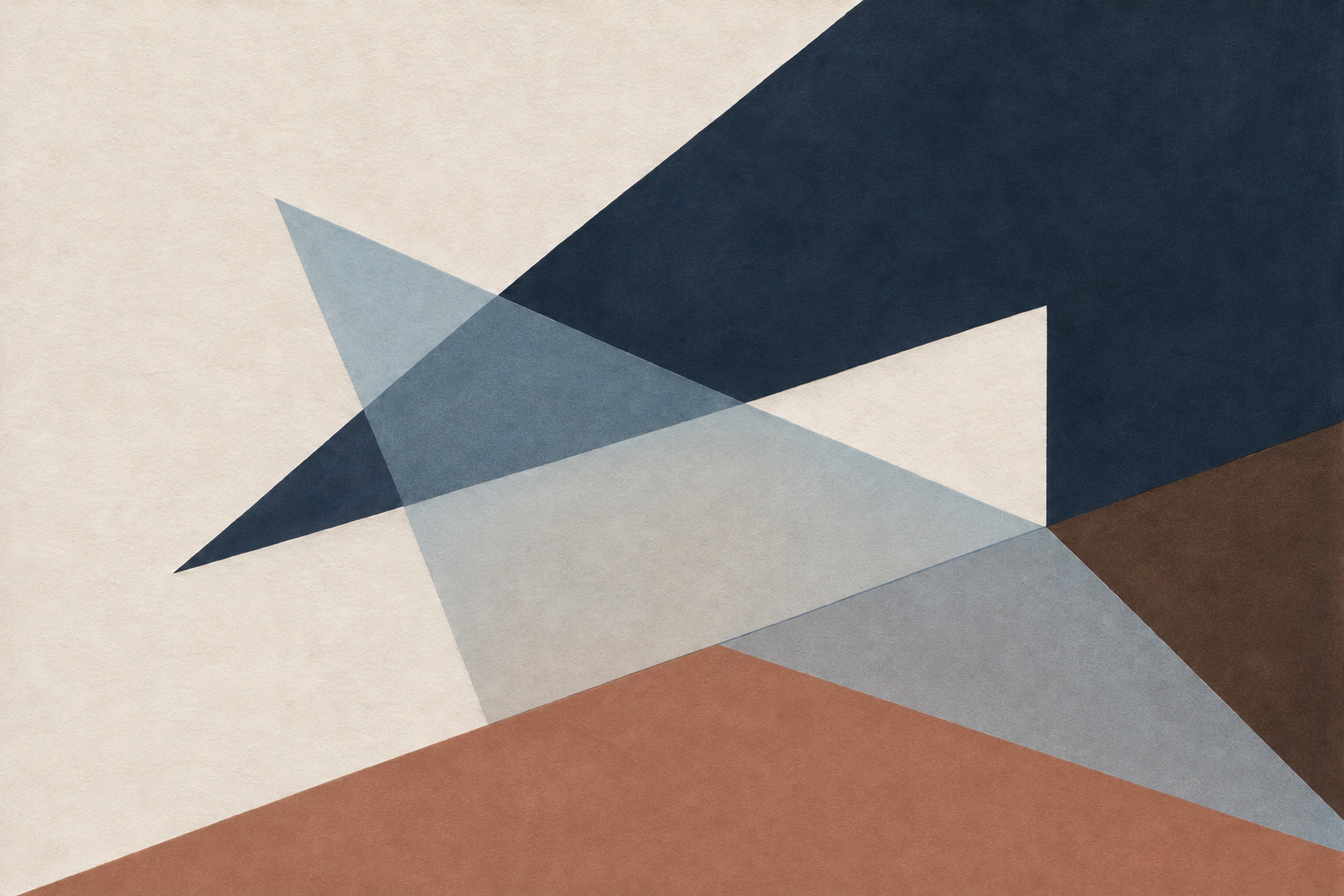
An edge gives the eye something to follow. At the meeting of the planes, it becomes harder to decide where we are.
A pale shape might be an opening, a surface, or the paper continuing between darker forms. A translucent passage lets one relationship remain visible through another. Following one edge can make a different part of the construction seem nearer or farther away.
Stay with the encounter
The forms offer clarity without settling every relationship. A Navy plane holds the darkest weight, while Clay and translucent Haze Blue introduce different conditions around it. The light interval holds its place between the larger masses. Its role can remain less definite than its edges.
There is time to remain with that uncertainty. We may find another reading, return to the first, or take pleasure in how the forms hold together. The work does not depend on discovering a hidden correct answer.
What becomes available when we give our first interpretation a little more time?
Where the idea began
Held Open began with John Keats's idea of negative capability: a capacity to remain with uncertainty and mystery without urgently forcing an explanation. He developed the thought in a December 1817 letter discussing literary achievement. Read the letter excerpt.
The digital artwork brings that question into shape, material, and space. Its paper and pigment are AI-assisted interpretations; the construction was developed for Abstraction's growing collection of visual inquiries.
Continue in the Index
Explore Held Open